
 Call us now:


On 2 September 2026, the Strategic Banking Corporation of Ireland (SBCI) published its 2026 SME Outlook Report, which tracks the financial sentiment, business priorities, operational challenges and borrowing behaviours of small and medium-sized enterprises (SMEs) across Ireland. The report drew on responses from 182 Irish SMEs surveyed between April and May 2026, comprising 51% micro, 37% small and 12% medium-sized firms, and showed increasing cost pressures in 2026 compared with 2025.
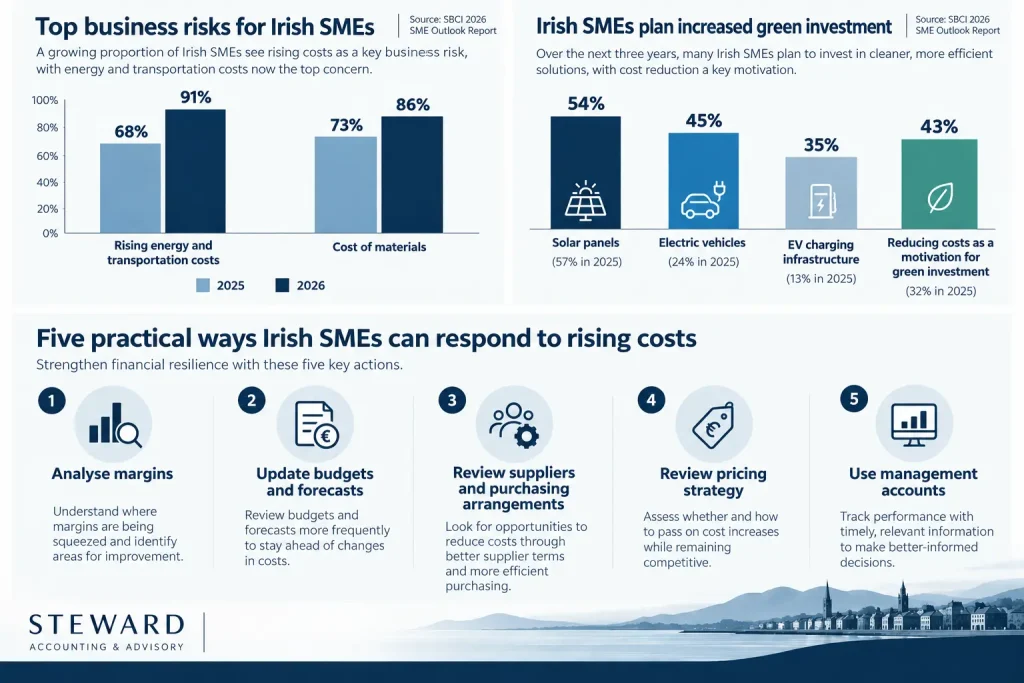
The report found that 91% of SMEs perceive rising energy and transportation costs as a key business risk, compared with 68% in 2025, making this the top-ranked business risk. The cost of materials ranked second, with 86% of SMEs identifying it as a key risk, compared with 73% in 2025.
Rising costs can threaten the viability and profitability of businesses. In this article, we explore five practical ways businesses can respond to this risk and better manage the impact of rising costs.
1. Analyse margins
Gross margin is the percentage of revenue that remains after subtracting the direct costs of producing goods or providing services, commonly referred to as the cost of goods sold or cost of sales. It is important to understand where margins are being squeezed within the business. Gross margin analysis helps reveal whether a business’ pricing model remains sustainable and can also help identify when rising direct costs are eroding the profit generated by individual products or services. The most effective way to analyse gross margin is by product, service type, segment, or business line. This level of analysis provides a better view of the performance of each product or service and prevents high-performing areas from masking hidden profit drains.
A squeeze on margins can be mitigated by adjusting pricing strategies, although this can be difficult where price increases could reduce demand or affect competitiveness. Businesses can alternatively look for opportunities to improve operational efficiency. This can include exploring lower-cost or more efficient energy sources, reducing waste, and identifying opportunities to lower direct costs. Supplier arrangements and pricing strategies, which can also help protect margins, are considered further below.
According to the same 2026 SME Outlook Report, over the next three years, 54% of businesses are planning to invest in solar panels (57% in 2025), 45% plan to acquire electric vehicles (24% in 2025) and 35% plan to invest in EV charging infrastructure (13% in 2025). The report also indicates that 43% of respondents identified reducing costs as a motivation for green investment, up from 32% in 2025. These findings suggest that some businesses are already considering green investment as one way of managing costs. For businesses that have not yet considered these options, it may be worth assessing whether such investments could deliver long-term cost savings, taking into account the initial investment required and the expected payback period.
2. Update budgets and forecasts more frequently
Budgets and forecasts are important and provide a financial roadmap that allows businesses to track financial performance against set targets and help guide decision-making. In a period of rising costs, annual budgets can quickly become outdated as costs change, and assumptions made at the beginning of the year may no longer be relevant. Frequent updates allow businesses to be more proactive in responding to changes in their operating environment. Through regular tracking, businesses can capture increases in the cost of materials, energy, and other operating costs. Timely updates of budgets also enable businesses to adjust product or service prices more quickly, where necessary, to preserve profit margins.
The use of rolling forecasts, which involves continuously updating financial projections by adding a new period as each period ends and maintaining, for example, a fixed 12- to 18-month horizon, can also help strengthen cash-flow forecasting in times of rising costs. This provides businesses with a forward-looking view of their financial position and allows them to assess the potential impact of changes in costs, revenue, and other key assumptions before making decisions.
3. Review suppliers and purchasing arrangements
Rising material costs can be a trigger for businesses to review their supplier agreements and purchasing arrangements to determine whether there are opportunities to achieve some cost relief. This includes assessing whether existing suppliers offer rebates, volume discounts, or other discounts that the business can take advantage of. Businesses may also consider renegotiating prices and payment terms with existing suppliers, particularly where they have a long-standing relationship or significant purchasing volumes.
Alternatively, businesses can consider whether there are lower-cost suppliers in the market or whether they can use alternative materials that are less expensive without compromising the quality of the product or service. Businesses can also review their purchasing patterns to identify unnecessary or inefficient purchases and consider whether consolidating purchases with fewer suppliers could provide greater negotiating power.
However, when considering alternative suppliers, businesses should look beyond the purchase price and consider the total cost of doing business with the supplier. Factors such as delivery costs, lead times, product quality and supplier reliability should also be considered, as these could offset any savings achieved through a lower purchase price.
4. Review pricing strategy
In many cases, businesses may be reluctant to increase prices, as doing so can affect their competitiveness or reduce customer demand. However, depending on the products or services sold, it is important to assess how the market is reacting to rising costs and whether some of these increases should be passed on to customers.
In doing so, it is important to understand the impact on margins under different pricing scenarios and paying particular attention to products or services with lower or declining margins. Businesses should also consider whether price increases need to be applied across the board or whether a more targeted approach may be appropriate for particular products, services or customers.
Pricing decisions should also take into account factors such as competitor pricing, customer sensitivity to price changes, and the value customers place on the product or service. Where increasing prices is difficult, businesses may need to consider other ways of protecting margins, including reviewing discounts, product or service offerings, or the cost of delivery.
5. Use management accounts to make better-informed decisions
In an environment of rising costs, monthly reporting, key performance indicator (KPI) tracking, budget-versus-actual analysis and analysis of margin trends can provide an early-warning system. Monthly management accounts are an effective tool for better decision-making, providing timely, data-driven insights into operations to help businesses make decisions on pricing and resource allocation. They also help with cost control and efficiency by identifying cost drivers and waste, allowing businesses to pinpoint cost overruns and inefficiencies. Comparing current results with budgets, prior periods and expected performance can also help identify emerging trends before they become more significant issues.
Where KPIs such as revenue growth percentage, revenue per customer, gross margin, net profit margin, EBITDA, revenue per employee and others are tracked as part of monthly reporting, they can provide businesses with valuable insights into business performance as well as an opportunity to identify and correct any deviations early. For example, a declining gross margin may indicate that increases in input costs are not being adequately reflected in selling prices, while rising operating costs as a percentage of revenue may highlight areas that require further investigation.
For monthly reporting to provide meaningful insights, reports and KPIs need to be customised to provide information that is most valuable to businesses. Customised internal reports tailored to specific services or product lines, geographic segments or departments can provide more relevant insights than rigid, generic reports. The aim should not simply be to produce more financial information, but to provide information that helps management understand what is changing in the business, why it is changing, and where action may be required.
What’s next?
Businesses cannot always control external factors such as increases in energy and transportation costs, as well as material prices. However, they can take a more proactive approach to identifying the financial impact of these increases and putting appropriate responses in place.
Businesses that are likely to be more resilient in this environment are those that have robust financial systems in place to provide relevant and timely insights into business performance, enabling them to take appropriate and timely mitigating action.
At Steward Accounting & Advisory, we help businesses gain better visibility over their financial performance through management accounts, KPI reporting, budgeting, cash-flow forecasting and other accounting and advisory services. Visit www.stewardaccounting.ie to learn more about our services or to get in touch.